
Too Many Deer!
How to Restore Forests, Wildflowers, and the Birds and the Bees in the Southern Gulf Islands

Herbivory—the eating of plants by animals—is usually a healthy part of the web of life. But when herbivore populations like deer, goats, or sheep soar without natural checks and balances, they can reshape—and even collapse—entire ecosystems.
Across the Gulf Islands, with few predators and limited hunting, deer and other grazers have browsed away the forest understory. The soft-leaved wildflowers and shrubs are gone, leaving only the tough survivors: sword fern, salal, nettle, and moss beneath aging conifers. Without shelter, seeds, or fruit, birds and pollinators have declined. This ecological collapse is well studied, and each island has its own twist on the same story.
Deer densities range from deer-free islets to over two deer per hectare on heavily browsed islands. On Mayne, surveys suggest 0.5–2 deer/ha—ten times what’s considered sustainable for forest and songbird recovery. (UBC researchers suggest < 0.1 deer/ha as a target.) The pattern is repeated across the archipelago: where deer and other feral grazers are dense, wildflowers and shrubs vanish.
The good news? Awareness is growing, and communities are testing innovative, collaborative solutions.
(When was the last time you walked through an indigo-petaled, blooming Camas meadow or stepped gingerly between a carpet of wild checkered-chocolate lilies and candy-pink Nodding Onion and Seablush blossoms? With all these grazing Black-tailed Deer around, diverse wildflower meadows and naturally regenerating forests have become a rare sight. The video above shows the contrast between areas exposed to grazers and fenced exclosures that protect shrubs and trees from browsing.)
Conversations with Island Experts
A few weeks ago, with high schoolers at the Saturna Ecological Education Centre (SEEC), we Zoomed with experts from Mayne, Lasqueti, and Salt Spring about this very topic, followed by a field trip with ecologists to the goat- and deer-ravaged forests of Saturna Island. Here’s what we learned:
Mayne Island / SḴŦAḴ
“Around 200 black-tailed deer could be sustainable,” says Rob Underhill, Biologist with the Mayne Island Conservancy since 2011. “Today they number in the thousands, including escaped Fallow Deer.” Raised on farms for venison, European Fallow Deer (Dama dama) have spread on Mayne and other Islands. With predators removed and hunting restricted since the late 1960s, wild and feral deer numbers have soared. Underhill emphasizes that the issue is “not just ecological but cultural—most people don’t know how to hunt and don’t really see deer as a food source.”
Lasqueti Island / Xwe’etay
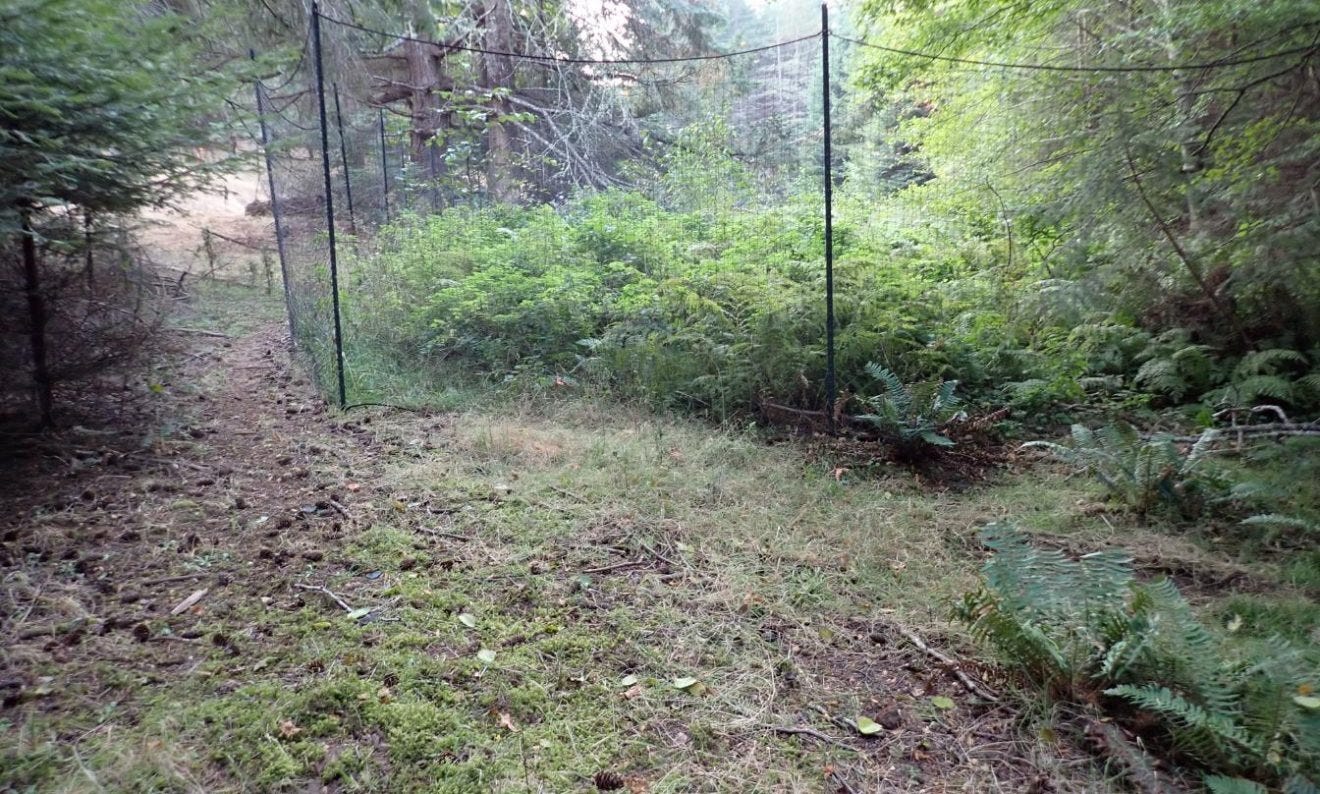
“In 1860, surveyors decided Lasqueti could support ten thousand sheep,” says Gordon Scott, President of the Lasqueti Island Nature Conservancy. “Now, with over a thousand feral sheep plus deer, the forest floor is moss and with no tree seedlings, under mature Douglas fir and cedar trees.” Community members are now building exclosures and monitoring vegetation recovery to make the case for change. Rather than hunting, some people favour a wild sheep sanctuary.
Salt Spring Island / ĆUÁN
Chris Drake of Coast Alive Stewardship Services helps build fenced exclosures and restore native plants for the Salt Spring Conservancy. Within these small refuges, native shrubs and wildflowers thrive—evidence that recovery is possible.
A UBC study of 56 plots across Salt Spring Island found that protected camas bulbs grew three times larger and wildflowers bloomed twelve times more in areas protected from deer. UBC’s Tara Martin Lab estimates 4,000–6,000 deer on Salt Spring—roughly ten times the ecological limit.Predators? “As opposed to Mayne, Lasqueti, and Saturna, there are always a few cougars on Saltspring. But, based on the poop I’ve seen, they seem to be mainly eating the invasive rabbits.” Chris notes, “Cars are deer’s main predator.”
Field Excursion on Saturna Island / ṮEḴTEḴSEN
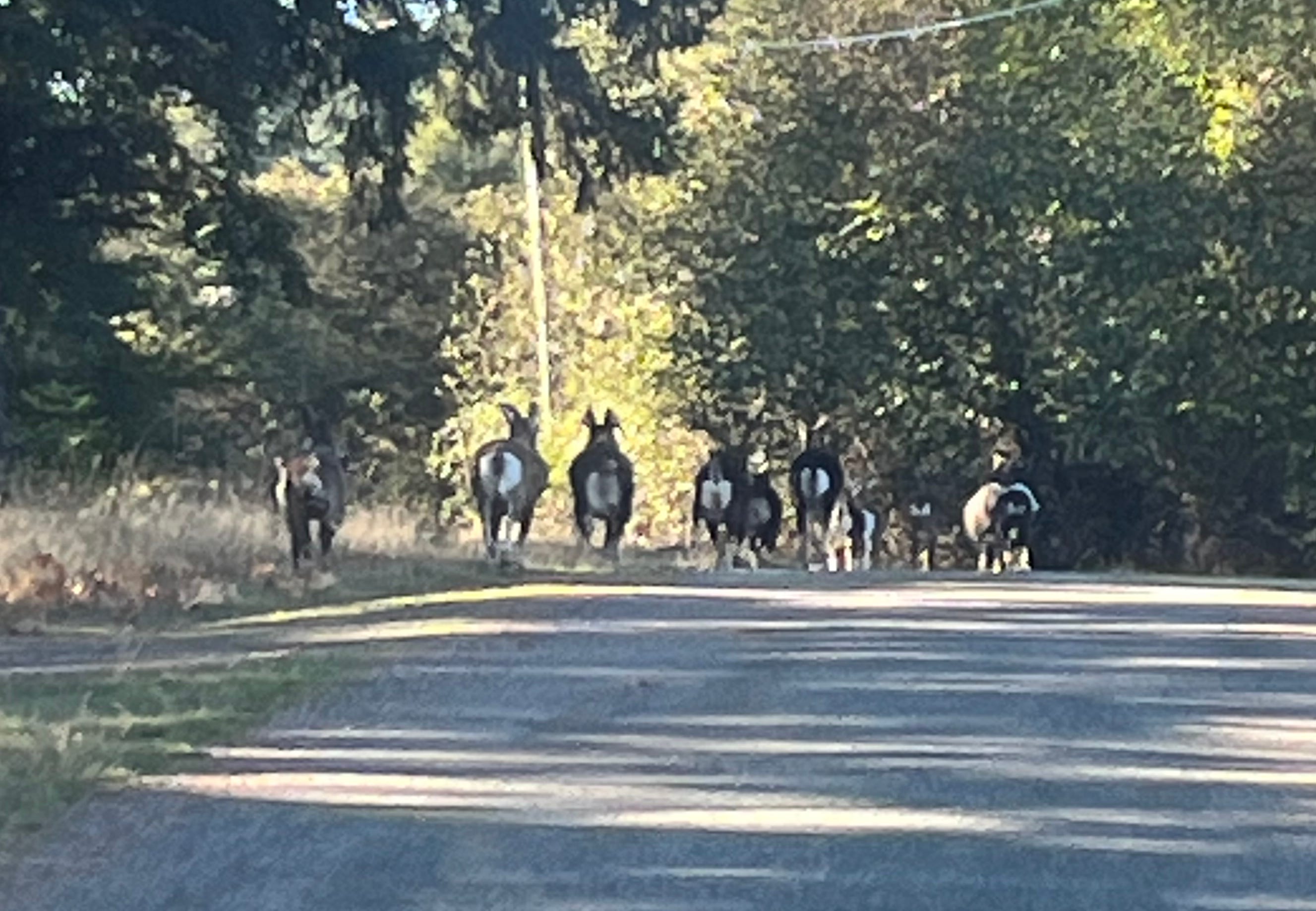
After the Zoom call, Drs. Mary Reid and Ralph Cartar, retired ecologists, invited us to visit their property. On the drive, herds of feral goats dashed up the hillsides—descendants of animals that escaped farms a century ago.
“On the south side of the island, people detest the goats because they eat everything,” Mary explained. “Even so, they’ve become emblematic of the area—there’s even a Feral Goat Bistro at the vineyard.”
Saturna’s coastal Garry oak slopes, she says, lack many expected native plants due to intense browsing. Between 2007–2013, Parks Canada monitored paired plots on Saturna and Sidney Islands to measure grazing effects. Inside fenced exclosures, shrubs and seedlings flourished. Outside, the ground was nearly bare.
Where Sidney Island saw recovery after the removal of 1,200 fallow deer, Saturna served as the control case—proof that without active management, recovery doesn’t happen.


Inspiring Island Examples:
Across the archipelago and beyond, communities are finding ways to restore balance.
SḰŦÁMEN (Sidney Island): Parks Canada and W̱SÁNEĆ partners are removing invasive fallow deer and replanting native shrubs. Exclosures show over 90% survival—proof the forest can rebound.
Galiano Island: The Galiano Conservancy and Penelakut Elders’ Feed the People workshops teach respectful deer harvesting and butchering.
Lummi Nation (Washington): Managed Indigenous hunting on Lummi and Orcas Islands maintains low deer densities while feeding community members.
Denman & Hornby Islands: Community deer working groups coordinate controlled hunts; Denman’s 2015–18 pilot led to measurable regeneration of salal and arbutus.
Tla’amin Nation (Texada & Lasqueti): Ahead of their Ɂəms ʔayɛ celebration, Tla’amin offered $250 per deer to local hunters, integrating cultural values with wildlife management.
Penelakut Island: Active hunting and cultural burning continue—many gardeners there don’t even need fences.
How to Fix It:
Educate and Inspire.
Share knowledge about the ecological impacts of overbrowsing. Watch Dr. Tara Martin’s talk on Hyperabundant Island Deer for a powerful overview.Support Hunters and Indigenous Practices.
Fallow deer are farmed for meat in Europe; goat is a traditional food for many in BC. Indigenous land management is based on eons of experience. It’s time to restore respectful, community-based connections with wild meat and the land.Consider Farm Sanctuaries
For the descendants of escaped farm animals, living out their natural lives in fenced farms with ample food and care could also be ideal.
Restore Native Plants
In protected areas, try planting a few wildflowers and fruit-bearing shrubs to support the birds and the bees! Many nurseries carry native species.
Build and Monitor Exclosures.
Lasqueti’s three-acre enclosure and Salt Spring’s fenced plots show how quickly nature rebounds when restored and protected.Welcome Predators.
Cougars and wolves play a key ecological role. Coexistence education can reduce conflict and rebuild natural balance. Salt Spring COCO (Cougar Coexistence Network) is a great resource.Protect Wild Corridors.
Keep large, undeveloped areas connected so cougars, deer, and native species can move safely, and traditional Indigenous stewardship practices—like prescribed burning—can continue.Celebrate.
Host festivals of wild foods and island biodiversity! Celebrate ecological restoration and community collaboration.
Conclusions
I think of the stark heathered hills of Scotland and Ireland—beautiful in their austerity, but really the scars of centuries of grazing. Those bare slopes were once dense, complex forests of oak and birch; The few plants that remain are unpalatable to grazers, such as wild rose, hawthorn, and nettles.
Here in the Southern Gulf Islands, we’re beginning to see the same pattern: open, simplified landscapes that look familiar to some settlers, but are in truth diminished versions of wild abundance and biodiversity.
Indigenous leaders, the Islands conservancies, and academics all agree. It will take fences, yes—but more than that, it will take courage. Courage to hunt again. To share meat and knowledge. To welcome predators. To imagine abundance instead of scarcity. Our positive role as active ecosystem stewards.
🌿 Further Reading, Listening & Watching
📚 UBC Research Summary of Deer Herbivory across the Gulf Islands
Concise explainer of how deer densities affect plants, pollinators, and birds.
🎧 Podcase Future Ecologies – “Dama Drama” A beautifully produced episode that unpacks the fallow deer crisis on Mayne Island.🔗
🦌 Video “Hyperabundant Island Deer” by Dr. Tara Martin Keynote address at the 2021 Galiano Conservancy AGM, shares bird and wildflower diversity impacts of over-browsing.
Addendum:
Lillian Underwood, a Cultural Mentor with the Tsawout Nation contacted me after I shared this article. She shared that the Aboriginal Coalition, working to end homelessness in Victoria, is seeking venison for community members. She requested to be contacted by anyone with venison to share at: 778-677-8097.
Big thanks to:
Bryn Pyper for sharing her notes from the Zoom and field excursion, to the SEEC students for their insights, to their teacher Ben Desrosiers for the podcast link and research project coordination, and to the many participants and resource people who have answered my questions and shared feedback. This field trip was funded by a HCTF (Habitat Conservation Trust Foundation) GO Grant.
An informative article Robin, thank you. And a reminder that there are ethical solutions to our deer overpopulation problem, bringing balance back to our local ecosystems 🌿
And this study just out by Tara Martin and team: https://www.researchgate.net/publication/397597042_Decision_analysis_rooted_in_Indigenous_and_Western_scientific_knowledge_identifies_cost-effective_strategies_for_managing_hyperabundant_deer_to_restore_keystone_places